
Georgia Chalvatzaki
TU Darmstadt
Speaker
Talk title to be announced
Does physical intelligence need structure?

What does it take to achieve the physical intelligence of a five-year-old? Children learn to manipulate new objects and generalize skills from only a handful of interactions. Despite rapid progress in vision and language, today’s robots remain far less data-efficient and lack comparably rich training data.
Structured Physical Intelligence (SPIN) asks how physical priors and structured world representations can close this gap. Relevant approaches include Visual-Language-Action models (VLAs), world models, object-centric and compositional representations, affordances, and particle-based models. Robotics provides a direct test of whether these ideas support efficient generalization for dexterous manipulation, hierarchical control, and few-shot learning.
The workshop brings researchers together to examine recent advances, current limitations, and open problems. The workshop will feature a live dexterous manipulation challenge that puts today’s robots side by side with a child, with invited talks and a panel discussion.
How do today’s robots compare with a child on everyday manipulation tasks?
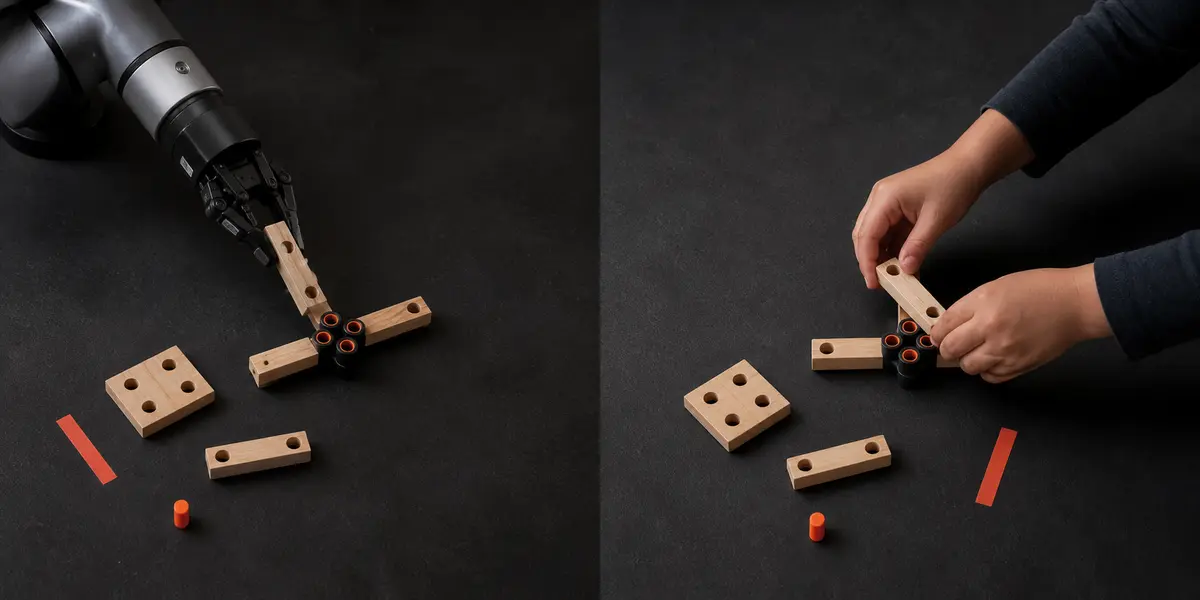
We invite researchers, students, and practitioners from academia and industry to test their robotic systems alongside a child on the same everyday household tasks. We will compare performance task by task to show what today’s robots can and cannot do and help participants learn from one another.
We will select three to five everyday manipulation tasks that a child can complete with familiar objects. We will share the final task list and simple completion guidelines before the event so teams can prepare.
The challenge features a $1,000 prize pool, sponsored by Scale AI.
We will provide a bimanual system with two YAM arms, based on the MolmoAct 2 setup, together with a dexterous Sharpa hand setup. Sharpa will support up to five teams with remote experiments and data collection.
We will share completion guidelines and details on timing, attempts, resets, and autonomy with teams before the event. We will provide a short, task-by-task summary of the demonstrations, with a focus on friendly comparison and shared learning.
The child and participating robotic systems will try the same tasks, giving the audience a familiar point of comparison.
Email the organizing team at roeiherz@gmail.com, amirb4r@gmail.com, or csferrazza@berkeley.edu with:
TU Darmstadt
Speaker
Talk title to be announced

Stanford University
Speaker & panelist
Talk title to be announced

Columbia University
Speaker
Talk title to be announced

AMI Labs
Speaker & panelist
Talk title to be announced
Tentative morning half-day schedule, in person, 8:30 AM–12:30 PM.
| 8:30 | Welcome — opening remarks, tasks and rules (10 min) |
| 8:40 | Keynote Talk 1: Georgia Chalvatzaki — 25 min + 5 min Q&A |
| 9:10 | Keynote Talk 2: Jeannette Bohg — 25 min + 5 min Q&A |
| 9:40 | Child–Robot Dexterity Challenge and Judging — 60 min |
| 10:40 | Keynote Talk 3: Yunzhu Li — 25 min + 5 min Q&A |
| 11:10 | Keynote Talk 4: Mike Rabbat — 25 min + 5 min Q&A |
| 11:40 | Break — 10 min |
| 11:50 | Panel: What is Next in Structured Physical Intelligence Models? — 30 min |
| 12:20 | Concluding remarks — 10 min |
| 12:30 | Adjourn |












Questions about the workshop can go to roeiherz@gmail.com, amirb4r@gmail.com, or csferrazza@berkeley.edu.
We gratefully acknowledge the support of our sponsors.